European Solid Wood Flooring
At Monarch Plank we create the finest handcrafted wide-plank hardwood flooring, finished with the latest European coloring and texturing techniques. Our floors feature top-quality construction for superior stability, sawn top layers, and long length boards. All of our Oak floors are made with Western European Oak, which we believe provides the best canvas for creating beautiful floors. American and Russian Oak simply cannot compare to the fine grain structure and color of true European Oak. Click here to learn more about why we don't use Russian Oak, for environmental, aesthetic and performance reasons. Monarch Plank Prefinished Engineered Flooring - in a variety of collections and price levels, stocked and ready for shipment. Monarch Plank Artisan’s Preferred Unfinished Engineered Flooring - favored by craftsmen who choose to finish their own flooring. Featuring a marine-grade Birch plywood substrate and thick, sawn top layers in European Oak, Walnut and Hickory. Get all the longevity of solid wood flooring with superior stability.
There is no finer unfinished wood flooring on the market. Monarch Plank ‘Finished-to-Order’ Prefinished Engineered Flooring – finished in our California factory using our Artisan’s Preferred unfinished platform. Choose from one of our gorgeous standard offerings, or create your own custom floor. Let your imagination be our guide. Custom Parquet - patterns that bring old world elegance into the most discerning spaces. Matching Moldings - including stair treads, to ensure that every last detail of your floor is complete. At Monarch Plank, we believe that a floor finish should enhance the natural beauty of the wood, not cover it. Many of our collections are coated with European oil finishes, which penetrate into the wood to become an integral part of it, rather than forming an artificial barrier on top. For those who prefer a more maintenance free floor, we are also proud to offer several collections of flooring coated with a matte urethane finish that mimics the look of oil, but requires less care.

Monarch Plank has been a leader in the use of advanced coloring techniques. Some of our most complex colors start with smoked or carbonized wood, where the wood color is changed from within before applying anything to it. Other floors are colored with products that create color by interacting with the natural compounds (tannins) in the wood. These ‘reactive stains’ provide a natural richness and variation that cannot be achieved with the pigments used in most stains and oils. Reactive stains can also be used to create antique effects that look truly authentic, giving the floors a time-worn appeal that is otherwise impossible to replicate. Because our unique coloring processes interact with rather than hiding the natural variation of the wood, each floor is uniquely its own and cannot be duplicated. Monarch Plank floors come in a wide variety of textures, including wire-brushed, hand-brushed, sand-blasted, and hand-scraped options. If you have a texture in mind that you don’t see among our standard collections, the master craftsmen in our California factory can texture your Monarch Plank ‘Finished-to-Order’ flooring to exactly your specifications.

The Monarch Plank Design Team works closely with top designers and European finish manufacturers, constantly experimenting with the latest products and processes. At the same time, we are committed to creating top-quality floors, and are careful not to introduce anything that hasn’t been thoroughly tested and proven.
Doctors Weight Loss Center Oxford MsWith nearly a century of hardwood flooring experience, we understand the importance of performance.
Dogs For Sale Blue Pitbulls Monarch Plank is connected to a network of skilled hardwood flooring professionals who represent and install our floors reliably.
Selling Used Tires TorontoOur installation partners include many of the most respected craftsmen in our industry. The entire team at Monarch Plank works hard to ensure that our flooring meets your requirements and expectations, from initial design to project completion.

We would like to assist you in beautifying your home to make your dream floor a reality and a unique reflection of you. We look forward to hearing from you. Monarch Plank is a Galleher Corporation company. Galleher has been distributing floor covering products on the West Coast for more than 76 years, leading the industry in designing, manufacturing, and distributing floor covering products for both residential and commercial applications. With the Clever 3 Layer Construction You have more installation options with our flooring than with solid wood flooring, making it much more versatile to the uniqueness each project brings. Glue Down Installation (Recommended) Screw or Nail-Down Installation Installation with Radiant Heat Floors Creative, Patient and Enthusiastic Simply the Best Engineered Wood Flooring Highest Quality and the Professionalism is Top Notch An example of solid wood flooring with a top coating of polyurethane
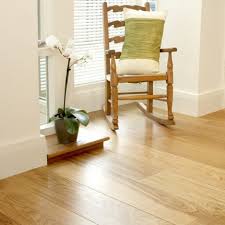
Wood flooring is any product manufactured from timber that is designed for use as flooring, either structural or aesthetic. Wood is a common choice as a flooring material and can come in various styles, colors, cuts, and species. Bamboo flooring is often considered a form of wood flooring, although it is made from a grass (bamboo) rather than a timber. Solid hardwood floors are made of planks milled from a single piece of timber. Solid hardwood floors were originally used for structural purposes, being installed perpendicular to the wooden support beams of a building known as joists or bearers. With the increased use of concrete as a subfloor in some parts of the world, engineered wood flooring has gained some popularity. However, solid wood floors are still common and popular. Solid wood floors have a thicker wear surface and can be sanded and finished more times than an engineered wood floor. It is not uncommon for homes in New England, Eastern Canada, and Europe which are several hundred years old to have the original solid wood floor still in use today.
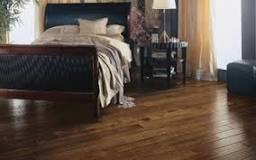
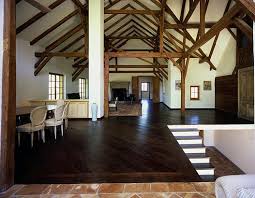
Solid wood flooring is milled from a single piece of timber that is kiln or air dried before sawing. Depending on the desired look of the floor, the timber can be cut in three ways: flat-sawn, quarter-sawn, and rift-sawn. The timber is cut to the desired dimensions and either packed unfinished for a site-finished installation or finished at the factory. The moisture content at time of manufacturing is carefully controlled to ensure the product does not warp during transport and storage. A number of proprietary features for solid wood floors are available. Many solid woods come with grooves cut into the back of the wood that run the length of each plank, often called 'absorption strips,' that are intended to reduce cupping. Solid wood floors are mostly manufactured .75 inches (19 mm) thick with a tongue-and-groove for installation. Oak Herringbone parquet floor with two strip wenge border This process involves treating the wood by boiling the log in water. After preparation, the wood is peeled by a blade starting from the outside of the log and working toward the center, thus creating a wood veneer.
The veneer is then pressed flat with high pressure. This style of manufacturing tends to have problems with the wood cupping or curling back to its original shape. Rotary-peeled engineered hardwoods tend to have a plywood appearance in the grain. This process begins with the same treatment process that the rotary peel method uses. However, instead of being sliced in a rotary fashion, with this technique the wood is sliced from the log in much the same manner that lumber is sawn from a log – straight through. The veneers do not go through the same manufacturing process as rotary peeled veneers. Engineered hardwood produced this way tends to have fewer problems with "face checking", and also does not have the same plywood appearance in the grain. However, the planks can tend to have edge splintering and cracking because the veneers have been submerged in water and then pressed flat. Instead of boiling the hardwood logs, in this process they are kept at a low humidity level and dried slowly to draw moisture from the inside of the wood cells.
The logs are then sawed in the same manner as for solid hardwood planks. This style of engineered hardwood has the same look as solid hardwood, and does not have any of the potential problems of "face checking" that rotary-peel and slice-peel products have, because the product is not exposed to added moisture. Wood flooring is a popular feature in many houses. Engineered wood flooring is composed of two or more layers of wood in the form of a plank. The top layer (lamella) is the wood that is visible when the flooring is installed and is adhered to the core. The increased stability of engineered wood is achieved by running each layer at a 90° angle to the layer above. This stability makes it a universal product that can be installed over all types of subfloors above, below or on grade. Engineered wood is the most common type of wood flooring used globally. The several different categories of engineered wood flooring include: All timber wood floors are made from sawn wood and are the most common category of engineered wood flooring.

They do not use rotary-peeled veneer, composite wood (such as HDF), or plastic in their construction. Veneer floors use a thin layer of wood over a core that is commonly a composite wood product. Acrylic-impregnated wood flooring uses a layer of wood that is impregnated with liquid acrylic then hardened using a proprietary process. Laminate and vinyl floors are often confused with engineered wood floors, but are not; laminate uses an image of wood on its surface, while vinyl flooring is plastic formed to look like wood. It is difficult to compare solid wood flooring to engineered wood flooring due to the wide range of quality in both product categories, particularly engineered. Solid wood has some limitations. Recommended maximum widths and lengths are typically 5" / 127mm wide and 7' / 2100mm long. Solid hardwood is also more prone to "gapping" (excessive space between planks), "crowning" (convex curving upwards when humidity increases) and "cupping" (a concave or "dished" appearance of the plank, with the height of the plank along its longer edges being higher than the centre) with increased plank size.
Solid wood can be used with under floor radiant heating.[2] However extra care is necessary with the planning and installation of the heating system and the wood flooring, such as limiting the temperature to 85 °F (29 °C), avoid sharp temperature fluctuations, utilizing an outdoor thermostat to anticipate heating demands, and monitoring the moisture content for the subfloor before installation. There are some characteristics that are common to each category: solid wood is more frequently site-finished, is always in a plank format, is generally thicker than engineered wood, and is usually installed by nailing. Engineered wood is more frequently pre-finished, has bevelled edges, is very rarely site-finished, and is installed with glue or as a floating installation. Engineered wood flooring has other benefits beyond dimensional stability and universal use. Patented installation systems allow for faster installation and easy replacement of boards. Engineered wood also allows for a floating installation where the planks are not adhered to the subfloor or to each other, further increasing ease of repair and reducing installation time.

Engineered flooring is also suitable for underfloor and radiant heating systems. Wood can be manufactured with a variety of different installation systems: The two most popular modern finishes for wood flooring are oil-modified urethane and water-based polyurethane. Within both categories there are many variations and other names used to describe the finish. Oil-modified urethane and water-based polyurethane also have very different refinishing and maintenance regimes. Generally, hardwood floors need to be buffed every 3–5 years. The process usually takes about one day. Buffing refers to the process of using a stand up floor buffer. The floor is abraded with 180 grit screen on the buffer. This allows for the new coat of finish to mechanically adhere to the floor. This process works with great results as long as the floor hasn't had any waxes or synthetic cleaners. Sanding the finish off old wood floors and smoothing them out. Sanding provides a method for smoothing an installed floor, compensating for unevenness of the subfloor.